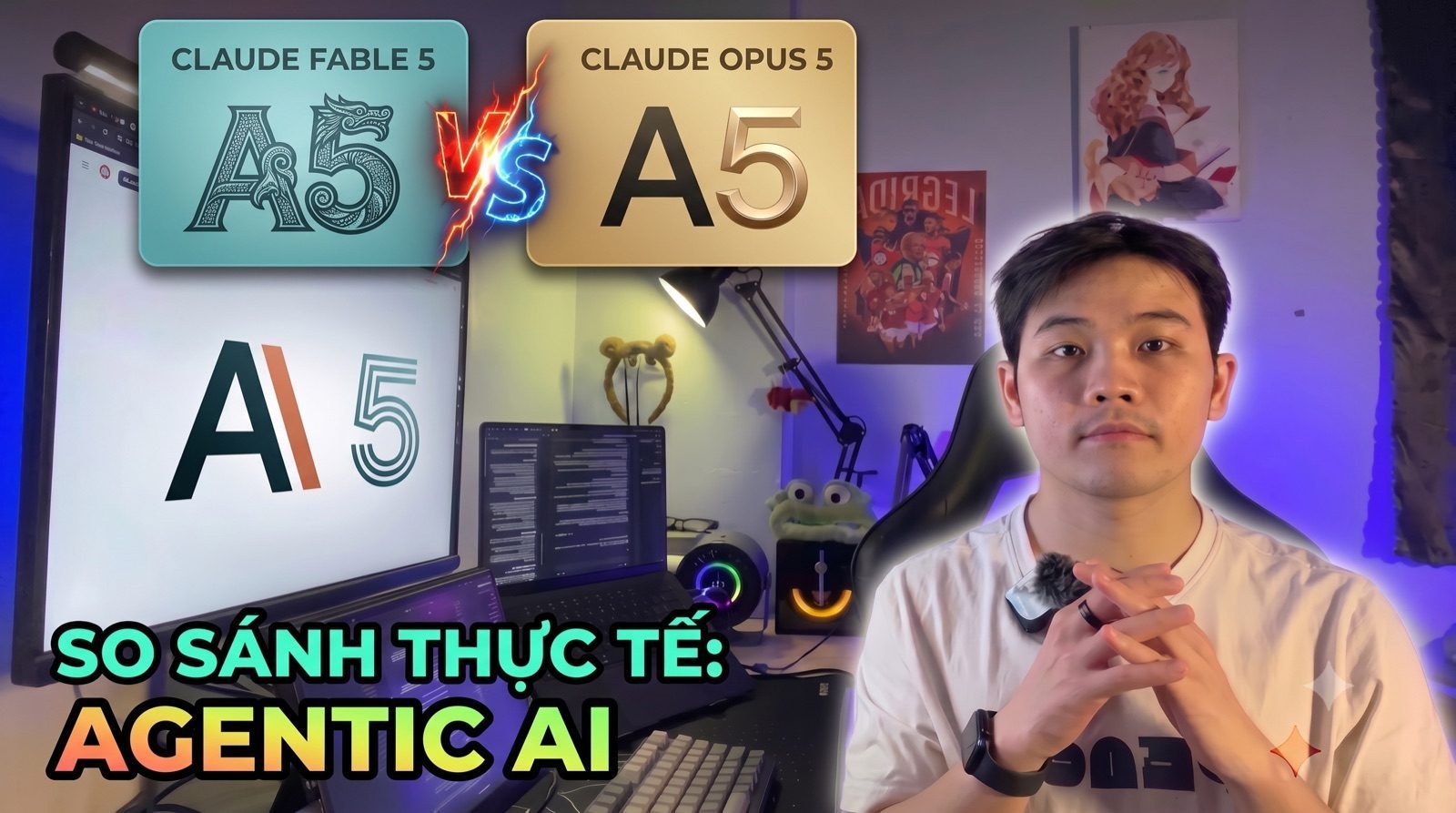
Claude Fable 5 vs Claude Opus 5: One Prompt, Two Models, One Excel File
Anthropic's pricing page makes a specific claim: Claude Opus 5 costs half what Claude Fable 5 costs. Not "a bit less" — exactly half, on both sides of the meter.
| Input / 1M tokens | Output / 1M tokens | |
|---|---|---|
Claude Fable 5 (claude-fable-5) | $10.00 | $50.00 |
Claude Opus 5 (claude-opus-5) | $5.00 | $25.00 |
So the question isn't whether Opus 5 is cheaper. It's whether you give anything up. I gave both models the same prompt, the same 8-sheet Excel spec, and no help — no MCP servers, no skills, no custom setup — and had them each build a landing page from scratch, running side by side.
This is the written companion to the video where both runs happen side by side — you can watch the plan appear in one pane and not the other, in real time.
Prefer to watch it on YouTube?
Watch on YouTube — or subscribe to the channel for the next comparison.
The setup
Two Claude Code sessions, in two separate folders so the generated code couldn't collide. One on Fable 5, one on Opus 5. Identical prompt, pasted into both.
The prompt asked each model to act as a frontend engineer and UI designer, and to:
- Produce a plan first, before writing any code, so I could review it
- Build in React + Tailwind
- Respect a set of output constraints
- Set up local development so I could run it
All the actual requirements lived in an Excel file — 8 sheets covering purpose, target audience, sitemap, design direction, a checklist, per-page detail, colours, and functions. Reading and honouring that spreadsheet was itself part of the test.
Whenever a model asked me a clarifying question, I answered both the same way.
What happened during the run
Four differences showed up while the two were still working. None of them are about the final pixels.
1. Only one model actually planned
The prompt asked for a plan before coding. Opus 5 followed the format and produced a detailed one. Fable 5 never produced a plan at all — it went straight to building.
That's a straightforward instruction-following miss, and it's the kind of thing you notice immediately when you're reviewing before you commit compute.
2. Only one model fixed its own errors
Both models hit errors while getting the project running. Fable 5 hit its error and stayed broken. Opus 5 hit its error, diagnosed it, fixed it, and got the dev server up without me intervening.
For autonomous work this is the difference that matters most. A model that stops at the first red console line needs a babysitter.
3. Only one model verified its own work
When Opus 5 finished coding, it produced two things unprompted: a structure walkthrough explaining what each part of the codebase does, and a verification table — what it checked, and how long each check took.
Fable 5 gave me the folder structure and nothing else. No self-check, no report.
4. Only one model left a README
Opus 5 wrote a summary README pulling the work together. Fable 5 didn't.
The numbers
Here is where it gets interesting, and where the "half price" framing needs a caveat.
| Claude Fable 5 | Claude Opus 5 | |
|---|---|---|
| Wall-clock time | ~11 min | ~20 min |
| Total cost | $6.00 | $6.79 |
| Context window used | 28% | 28% |
The costs came out nearly identical — despite Opus 5 being half the price per token.
That is not a contradiction, it's arithmetic. Opus 5 ran roughly twice as long and produced substantially more: a plan, more code, self-repair, a verification pass, a README. Half the unit price times about twice the volume lands you back in the same place.
The honest reading: you don't automatically save money by switching to Opus 5 — you get more work done for the same money. Whether that's a win depends on whether you wanted that extra work.
The output
The brief was a landing page for a Japanese-language school. Both models delivered something working, with a colour-theme switcher. The difference was in completeness.
| Fable 5 | Opus 5 | |
|---|---|---|
| Navigation | Intro, courses, mock test, blog, contact | Home, intro, courses, free mock test, level check, blog, student reviews, phone |
| Animation | none | falling petals, logo motion, marquee text |
| Google Map | not rendered | rendered |
| Footer | sparse | full |
| Pricing & schedule | present | present |
Opus 5's layout was the stronger of the two, and it reached further into the spreadsheet — the extra nav items and the map are requirements that were sitting in those 8 sheets. Fable 5's page was a correct but thinner reading of the same spec.
What I take from this
For agentic coding specifically — where the model plans, executes, hits errors, and has to recover without a human in the loop — Opus 5 did the more complete job here, at half the per-token price.
Two caveats I want to be explicit about:
This is one run, not a benchmark
n = 1. One prompt, one spec, one afternoon. Both models are non-deterministic; a second run could order them differently. Treat this as a worked example of how the two behave, not as a measurement of which is better.
Fable 5 is still the top capability tier
Anthropic positions Claude Fable 5 as its most capable widely released model, aimed at the most demanding reasoning and long-horizon agentic work. This test — build a landing page from a spreadsheet — is a coding-and-instruction-following task, not a hard-reasoning one. A result on this shape of problem doesn't transfer to problems shaped differently.
What it does tell you: if your workload looks like this one — spec in, working app out, minimal supervision — Opus 5 is worth benchmarking on your own tasks before you keep paying Fable 5 rates out of habit.